⚠ Do now
Cybersecurity · January 2026
Ransomware Prevention: Essential Strategies to Protect Your Business
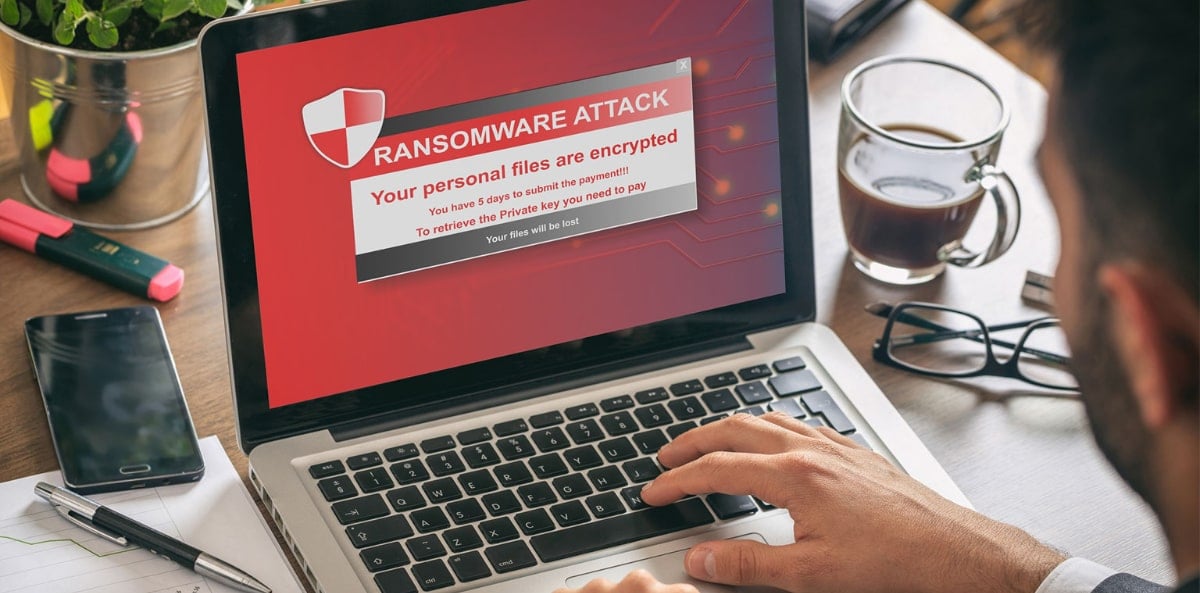
Your computer screen suddenly locks, displaying a menacing message demanding payment. This nightmare scenario is why ransomware prevention has become critical for every business. Learn proven strategies backed by the latest 2025 research to protect your organisation from devastating attacks.
Key Takeaways
- Ransomware attacks increased 37% in 2025, with 44% of all data breaches now involving ransomware (Verizon DBIR 2025)
- The average ransomware incident costs $5.08 million, and 1 in 5 affected SMBs filed for bankruptcy or closed permanently
- 64% of victims refused to pay in 2025 and recovered via backups. The enhanced 3-2-1-1-0 backup strategy is the single most effective defence
- 47% of attacks are now stopped before encryption begins. Early detection and a tested response plan are critical to minimising damage
Ransomware prevention has become essential for every business as malicious software continues to encrypt victims' files and systems, rendering them inaccessible until a ransom is paid. What started as simple file-locking schemes has evolved into sophisticated operations targeting critical infrastructure, making understanding how to protect against ransomware in 2026 more important than ever. According to Verizon's 2025 Data Breach Investigations Report, ransomware attacks increased by 37% in 2025.
The threat landscape has shifted dramatically, emphasising the critical need to prevent ransomware attacks before they occur. Modern ransomware groups don't just encrypt data - they steal it first, threatening to publish sensitive information if victims refuse to pay. This double extortion tactic has proven devastatingly effective, with Fortinet reporting that publicly reported attacks rose to 7,200 in 2025 compared to 4,900 in 2024 - a 47% increase. Without proper ransomware prevention measures, your business is at significant risk.
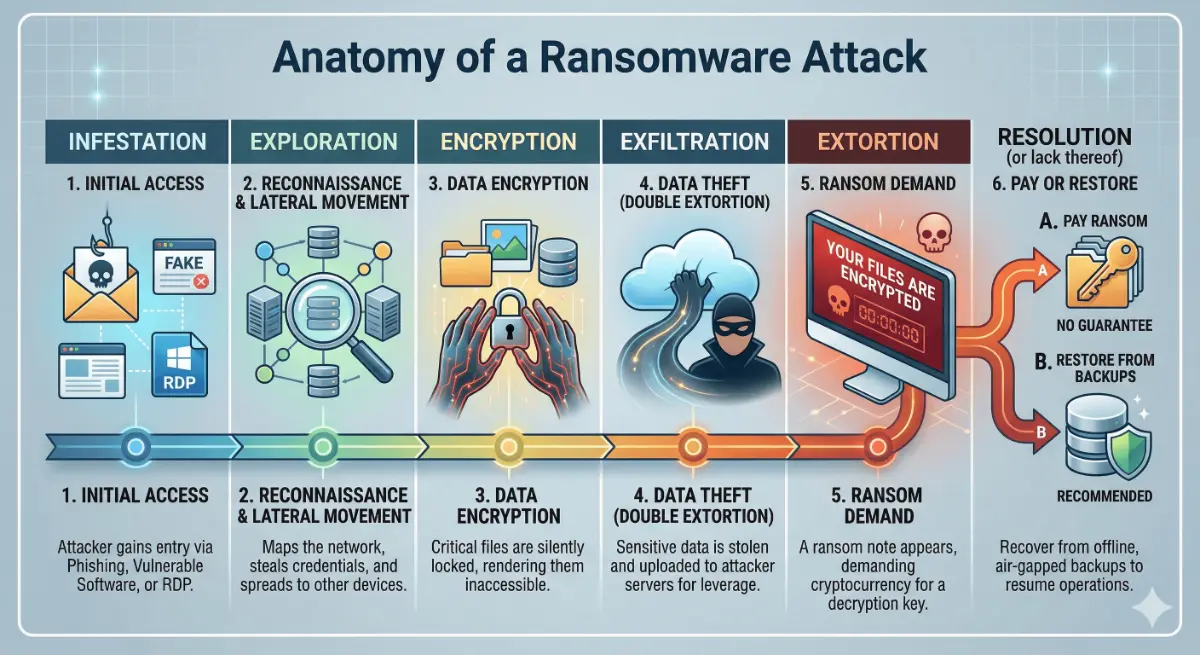
Attack Anatomy
How Ransomware Works
A ransomware attack follows a predictable pattern that exploits both technical vulnerabilities and human psychology. According to Sophos' State of Ransomware 2025 report, 32% of ransomware incidents started with exploited vulnerabilities, making this the most common technical cause, followed by compromised credentials (23%) and phishing (18%).
The encryption phase represents the attack's most devastating moment. Advanced ransomware uses military-grade encryption algorithms to lock files, making them completely inaccessible without the decryption key. The median time from initial intrusion to ransomware execution dropped to just 5 days in 2025.
Key Insight: Dual-Threat Approach
What makes modern ransomware particularly insidious is its dual-threat approach. Beyond encrypting files, modern variants often exfiltrate sensitive data before deployment, creating leverage through the threat of public exposure. Recorded Future reports that approximately 50% of all tracked attacks now include data theft and extortion components.
Know Your Enemy
Types of Ransomware
Effective ransomware prevention requires understanding the different types of threats you're defending against. Each employs different tactics, and understanding these variations is crucial for developing effective ransomware protection strategies.
| Type | How It Works | Threat Level | Notable Groups |
|---|---|---|---|
| Crypto Ransomware | Encrypts files, making them completely inaccessible | Critical | Qilin, Akira |
| Locker Ransomware | Freezes entire system rather than specific files | High | Various |
| Double Extortion | Steals data before encrypting, threatens to publish | Critical | Medusa, RansomHub |
| RaaS (Ransomware-as-a-Service) | Subscription platforms enabling less-skilled attackers | Critical | LockBit (disrupted), various |
According to Cyfirma research cited by Fortinet, Qilin became the most active ransomware group by June 2025, carrying out 81 attacks in a single month - a sharp 47.3% rise. Meanwhile, Dragonforce surged dramatically with attacks jumping 212.5%.
Early Detection
Ransomware Detection: Warning Signs You Must Know
Ransomware detection is a critical component of any ransomware prevention strategy. Sophos reports that 47% of attacks are now stopped before encryption begins - more than double the 22% rate in 2023. Early detection is where ransomware prevention succeeds or fails.

Warning Signs Checklist
0 / 8
Computer suddenly becomes sluggish or unresponsive
Files have strange extensions you don't recognise
Files that worked yesterday won't open now
Desktop wallpaper changed to a ransom message
Suspicious network activity or spikes detected
Unexpected system crashes or program failures
Fake antivirus or security warnings appearing
New files named "README" or "DECRYPT" on desktop
Immediate Action Required
If you suspect an infection, disconnect from the internet immediately to prevent further encryption and contact IT security professionals. According to CISA's #StopRansomware Guide, the faster you act, the better your chances of minimising damage. Do not power off devices as this may destroy valuable forensic evidence.
Real Costs
What Happens If You Get Ransomware? Business Impact
When ransomware strikes, the immediate impact extends far beyond locked files. According to IBM's 2025 Cost of a Data Breach Report, 86% of organisations reported operational disruptions including delayed sales, interrupted services, or halted production. This is exactly why investing in ransomware prevention pays for itself many times over.
Watch: Ransomware Prevention Explained
The financial implications are staggering:
- Healthcare breaches remain the most expensive at $7.42 million average - the highest across any industry for the 14th consecutive year (IBM 2025)
- U.S. data breaches hit a record $10.22 million average, a 9% increase from 2024 (CyberScoop)
- Recovery time averages over 100 days, with a quarter of organisations needing 126-150 days (IBM 2025)
- Nearly 1 in 5 SMBs that suffered a cyberattack filed for bankruptcy or closed (Mastercard via Fortinet)
While most published ransomware costs reflect global averages, Australian businesses face similar exposure. The ACSC reported average cybercrime costs for Australian businesses reached $80,850 in 2025, with ransomware costs in Australia continuing to climb as attacks increasingly target local SMBs and government agencies.
Defence Strategy
Ransomware Prevention Strategies
These ransomware prevention strategies for business remain the most cost-effective approach. Organisations with comprehensive incident response plans recover 50% faster than those responding reactively. Here's what CISA, FBI, NSA, and MS-ISAC recommend:

1
Implement Robust Backup Systems
Maintain multiple backup copies using the 3-2-1-1-0 rule: 3 copies, 2 media types, 1 offsite, 1 immutable, 0 errors. Test restore procedures regularly. Veeam recommends adding immutable backups as ransomware increasingly targets backup systems.
2
Employee Security Training
With 18% of ransomware attacks starting through phishing (up from 11% in 2024), regular training is essential. DeepStrike reports that 2025 phishing attacks now include AI-generated emails that mimic company tone and deepfake voice calls impersonating executives.
3
Network Segmentation
Divide your network into isolated segments to limit lateral movement. If one segment is compromised, others remain protected. CISA recommends implementing zero trust architecture to prevent unauthorised access.
4
Patch Management
32% of ransomware incidents in 2025 started with exploited vulnerabilities (Sophos). Verizon found that almost half of perimeter-device vulnerabilities remained unresolved.
5
Deploy EDR Solutions
Endpoint Detection and Response tools can identify ransomware through behavioural analysis. IBM reports organisations using AI tools extensively cut their breach lifecycle by 80 days and saved nearly $1.9 million on average.
6
Test Incident Response Plans
Create and regularly test your response procedures through tabletop exercises. CIS recommends using the #StopRansomware Guide's response checklist as a foundation.
Data Protection
The 3-2-1 Backup Strategy for Ransomware Protection
The 3-2-1 backup rule has been a foundational guideline for data protection and ransomware prevention for nearly two decades. However, as Acronis notes, the immense rise of ransomware attacks calls for enhancing the basic principles to 3-2-1-1-0.
The 3-2-1-1-0 Backup Strategy
TAP TO EXPLORE3Copies
2Media
1Offsite
1Immutable
0Errors
3 Copies of Your Data
Maintain three copies of your data at all times: the original working copy plus two backups. If one copy is compromised by ransomware, you still have two clean copies to restore from. A single backup is not enough - drives fail, backups get corrupted, and ransomware specifically hunts for backup files.
Why is the immutable copy essential? According to Arcserve, hackers now recognise that targeting backups makes it challenging - if not impossible - for victims to recover without paying. Immutable backups are saved in a write-once-read-many format that can't be altered or deleted, even by hackers with admin credentials.
Incident Response
Ransomware Response Plan: What To Do If Attacked
When a ransomware attack strikes, your immediate response determines whether you face weeks of downtime or a manageable recovery. Even the best ransomware prevention cannot guarantee 100% protection, so every business needs a tested response plan. Follow the CISA-recommended response checklist:

- Isolate immediately - Disconnect affected systems from the network to prevent lateral spread, but avoid powering down devices
- Document everything - Screenshots, error messages, and timelines become crucial for recovery and law enforcement
- Contact your response team - Engage cybersecurity professionals immediately, even before fully assessing damage
- Report to law enforcement - IBM reports that involving law enforcement reduced breach costs by nearly $1 million on average
- Assess backup integrity - Before considering payment, evaluate your backup systems and recovery options
- Preserve forensic evidence - Especially volatile data like system memory and Windows Security logs
Important: Law Enforcement Involvement Declining
Despite clear benefits, fewer victims are involving law enforcement - only 40% in 2025 compared to 52% in 2024. This is concerning because 63% of ransomware victims that involved law enforcement avoided paying ransom entirely.
The Dilemma
To Pay or Not to Pay
When facing a ransomware attack, organisations encounter a difficult decision. While payment might seem like the quickest solution, it carries significant risks:
- Only 60-65% of paying organisations recover their data (Varonis)
- 64% of ransomware victims refused to pay in 2025, up from 50% two years ago (Verizon DBIR 2025)
- Payment funds criminal enterprises and may violate OFAC regulations
- Many victims face repeat attacks from the same threat actors
The good news: Sophos reports median ransom demands fell 56% year-over-year to $1.20 million in 2025, and median payments declined to $1 million. This trend reinforces why ransomware prevention remains far more cost-effective than dealing with the aftermath.
Looking Ahead
Future Implications: Evolving Ransomware Threats in 2026
The ransomware landscape continues to evolve rapidly, making ongoing ransomware prevention investment essential. According to Recorded Future, here are the emerging trends to watch:

- DDoS-as-a-Service offerings - Ransomware groups adding DDoS attacks to pressure victims
- Insider recruitment increasing - Groups recruiting native English speakers to target corporate insiders
- Global expansion - 2026 may be the first year new ransomware actors outside Russia outnumber those within it
- AI-powered attacks - MIT research cited by Varonis found 80% of ransomware attacks now leverage AI tools
- Supply chain targeting - Third-party involvement doubled to 30% of all breaches in 2025
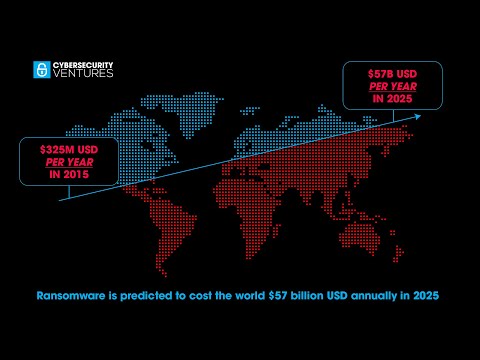
Mimecast projects the global impact of ransomware will reach $57 billion in 2025 - approximately $156 million per day - making proactive ransomware prevention the only sustainable defence.
Sources & References
Common Questions
Frequently Asked Questions
Common signs include a ransom note on your screen, sudden computer slowness, files with strange extensions (.locked, .encrypted), files that won't open, changed desktop wallpaper, and suspicious network activity. According to Sophos, 47% of attacks are now stopped before encryption in 2025, making early detection crucial. If you notice any warning signs, disconnect from the internet immediately.
Experts and law enforcement generally advise against payment. According to Verizon's 2025 DBIR, 64% of ransomware victims refused to pay. Varonis reports only 60-65% of paying organisations recover their data, and CISA notes that payment doesn't guarantee recovery and funds criminal enterprises.
The 3-2-1 backup rule means keeping 3 copies of data, on 2 different media types, with 1 stored offsite. For modern ransomware protection, experts now recommend 3-2-1-1-0: adding 1 immutable/air-gapped copy that can't be altered by attackers, and ensuring 0 recovery errors through regular testing.
According to IBM's 2025 report, the average ransomware/extortion incident costs $5.08 million. Healthcare breaches average $7.42 million. U.S. breaches hit a record $10.22 million average. Recovery typically takes over 100 days.
Top ransomware targets include: Healthcare, Financial services, Manufacturing, Construction, Government, Education, Energy/utilities, and Professional services. Verizon reports ransomware involvement in 88% of SMB breaches.
Already Hit by Ransomware?
If your Brisbane business has been hit, our forensic data recovery specialists can help you explore recovery options - even when you choose not to pay the ransom. Wildfire is Brisbane's only lab offering ransomware recovery with forensic-grade evidence handling.

Keep Reading

