⚠ Do now
SD-card recovery case study · Annaka
CASE STUDY: An empty DCIM folder: rebuilding Annaka’s action-camera videos.
A SanDisk card appeared to have no usable file system. The recovered videos carried misleading dates, and the requested count crossed a format boundary. Reconstructing the footage was only part of understanding the result.

The documented result
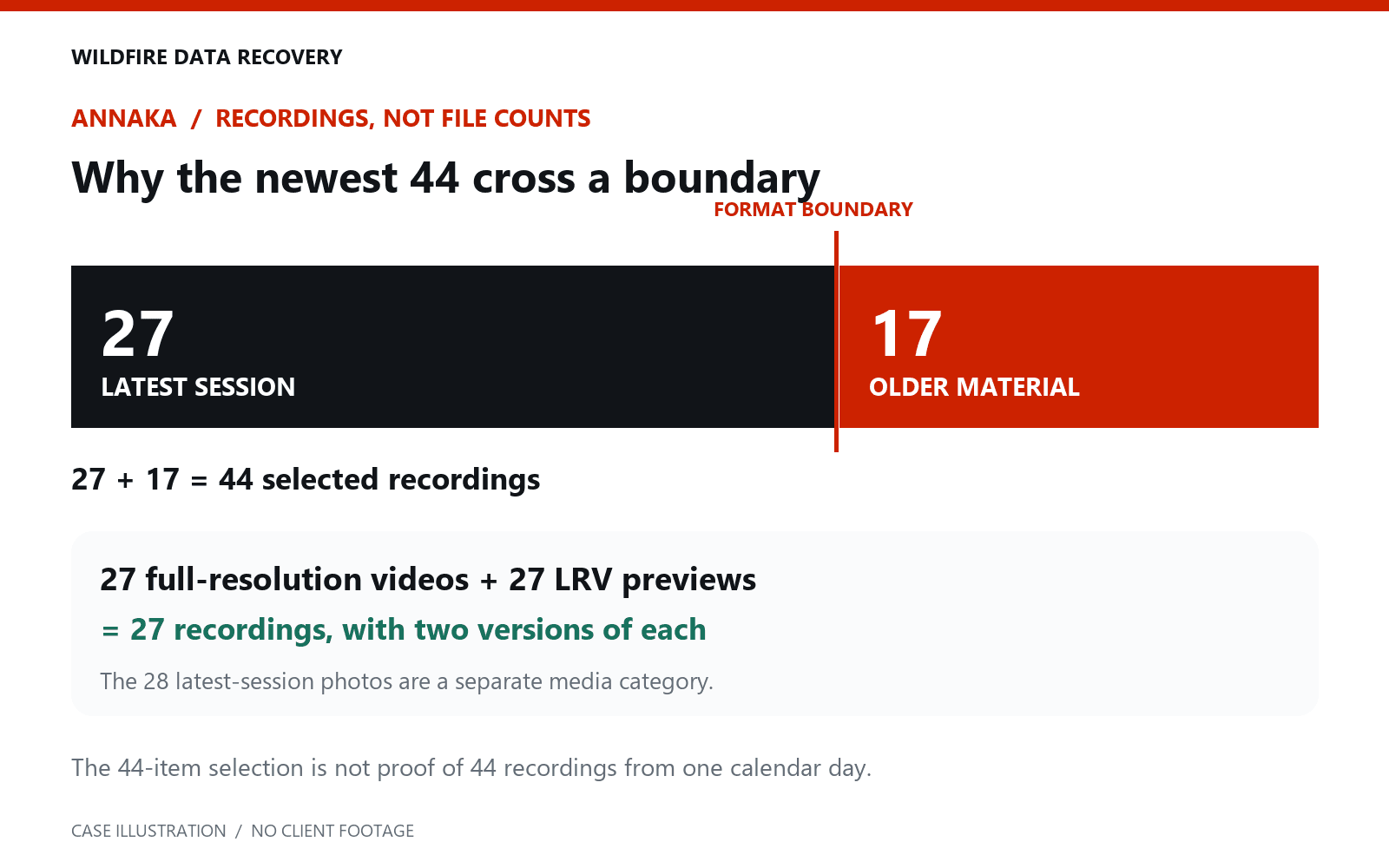
WDR’s reconstruction findings recorded 27 complete videos in the latest session, each with its 4K file and low-resolution preview, plus 28 photos that decoded. Selecting the newest 44 recordings required adding 17 from older material. That selection did not establish that 44 videos belonged to the requested day.
IN THIS ARTICLE
- 01The starting point: an empty folder and difficult reads
- 02Formatting had changed the recovery question
- 03The technical distinction: readable sectors versus reconstructable files
- 04Why footage labelled 2019 could still matter
- 05The latest session contained 27 recordings
- 06Why the newest 44 crossed into older footage
- 07Older material needed separate quality labels
- 08What this case teaches about SD-card recovery
- 09Questions this case helps answer
Engineering notes / 01
The starting point: an empty folder and difficult reads
Annaka brought a 64 GB SanDisk SD card to Wildfire Data Recovery after losing access to action-camera footage. The DCIM folder appeared empty, and the initial PC-3000 examination did not recognise a usable file system. Access was limited to the underlying data.

Early imaging was also concerning. Progress became extremely difficult around the 29–30 GB region, and an attempt covering roughly 30–40 GB took close to 12 hours in the reported write-blocked setup. WDR paused routine attempts rather than continuing to push through the same behaviour without reassessment.
At that point, physical media damage was a possibility, not a confirmed diagnosis. An empty directory, slow reading and a missing file system do not individually establish a damaged NAND chip. The analysis needed to distinguish acquisition difficulties from damage to the structures used to locate and assemble files.
A later Oxygen Forensic Detective acquisition produced a full image. The acquisition was reported as completing without read errors, although subsequent work across multiple images identified residual unreadable sectors. Those observations need to be kept separate: the later reconstruction findings do not justify a claim that every original byte was available.
Engineering notes / 02
Formatting had changed the recovery question
The reported history included formatting and attempts with Disk Drill and PhotoRec before the card reached this stage of the investigation. The precise format method, settings and destinations used for those attempts were not established. We did not attribute damage to a particular application or person.
“Formatted” is not a complete technical description. Different operations can affect file-system information and stored content differently. The SD Association distinguishes quick formatting from overwrite formatting in its formatter guidance. What actually happened to this card had to be assessed from the surviving evidence.
For this recovery, restoring a familiar folder name would not be enough. The task was to identify surviving video structures, rebuild recordings, establish their completeness and separate recent material from remnants of earlier sessions. That distinction became essential when the requested number of clips did not match the latest recorded area.
Engineering notes / 03
The technical distinction: readable sectors versus reconstructable files
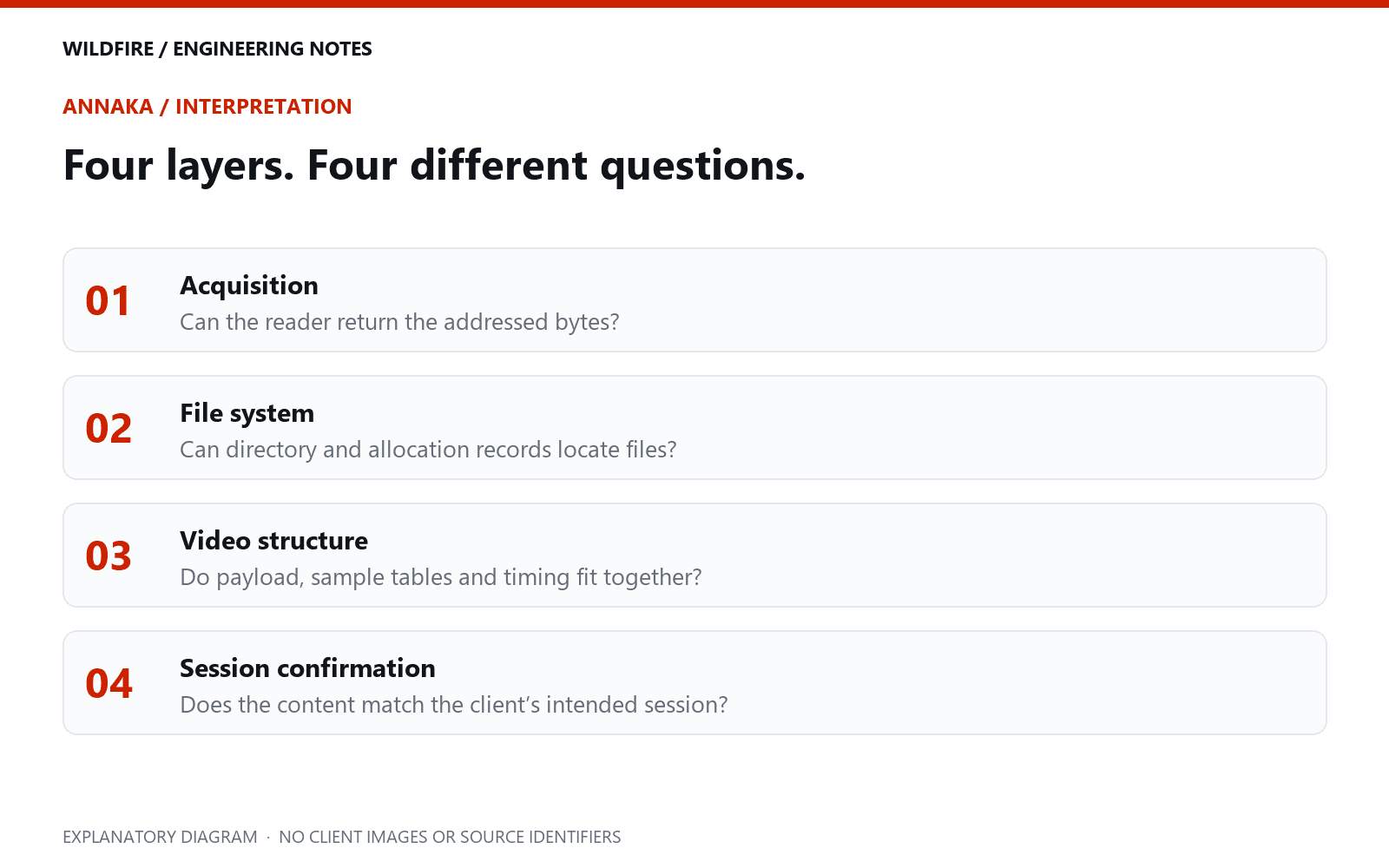
Acquisition and file interpretation answer different questions. Acquisition asks which logical block addresses a reader can return. File-system analysis asks which of those addresses belong to a named file. Video reconstruction then asks how the surviving payload and index structures fit together. A success at one layer does not automatically establish success at the next.
| Layer | Observation in this case | What it does not establish |
|---|---|---|
| Card access | Difficult early reads, then a later full-image acquisition. | A specific controller or NAND fault has not been proven. |
| File system | Initial PC-3000 examination was RAW-only and the DCIM view appeared empty. | RAW access does not mean a direct physical NAND dump, or that every video payload is erased. |
| Video structure | Camera-table sample verification was reported for the latest 27 recordings. | A file signature or plausible duration alone would not prove completeness. |
| Decoded content | All latest-session recordings and 28 photos were reported to decode. | The actual calendar day still needs corroboration. |
“No read errors” in an acquisition summary is a tool-reported result for that acquisition. It does not inspect whether the returned bytes contain valid file-system records, correctly ordered video samples or the footage the client remembers. Conversely, the later report of unreadable sectors needs the corresponding maps and acquisition settings to reconcile it with the earlier summary. We do not erase that distinction when describing the outcome.
What camera sample-table verification contributes
For a conventional indexed MP4, the movie metadata can describe how samples are distributed through chunks, their sizes and their timing. Reconstruction has to respect those relationships. A media payload joined to the wrong index may have a plausible extension and even open briefly while failing later in the sequence.
That is why the documented result for the latest 27 matters: WDR reported verification against the camera’s own tables as well as error-free decoding. The article does not substitute the presence of an LRV preview for checking its full-resolution partner. Each version is a separate file, even though the two represent the same recording event.
The exact Annaka recovery-source scripts are not included in the available case record for this article. We therefore describe the reported table checks without presenting newly written sample code as the original recovery engine. The Sony case study includes excerpts from the actual local reconstruction scripts where their provenance is available.
Engineering notes / 04
Why footage labelled 2019 could still matter
Annaka’s target was footage reported to have been recorded in September 2026 on a Kaiser Baas X600. Recovered material displayed dates in 2019. At first glance, those files could look unrelated to the request.
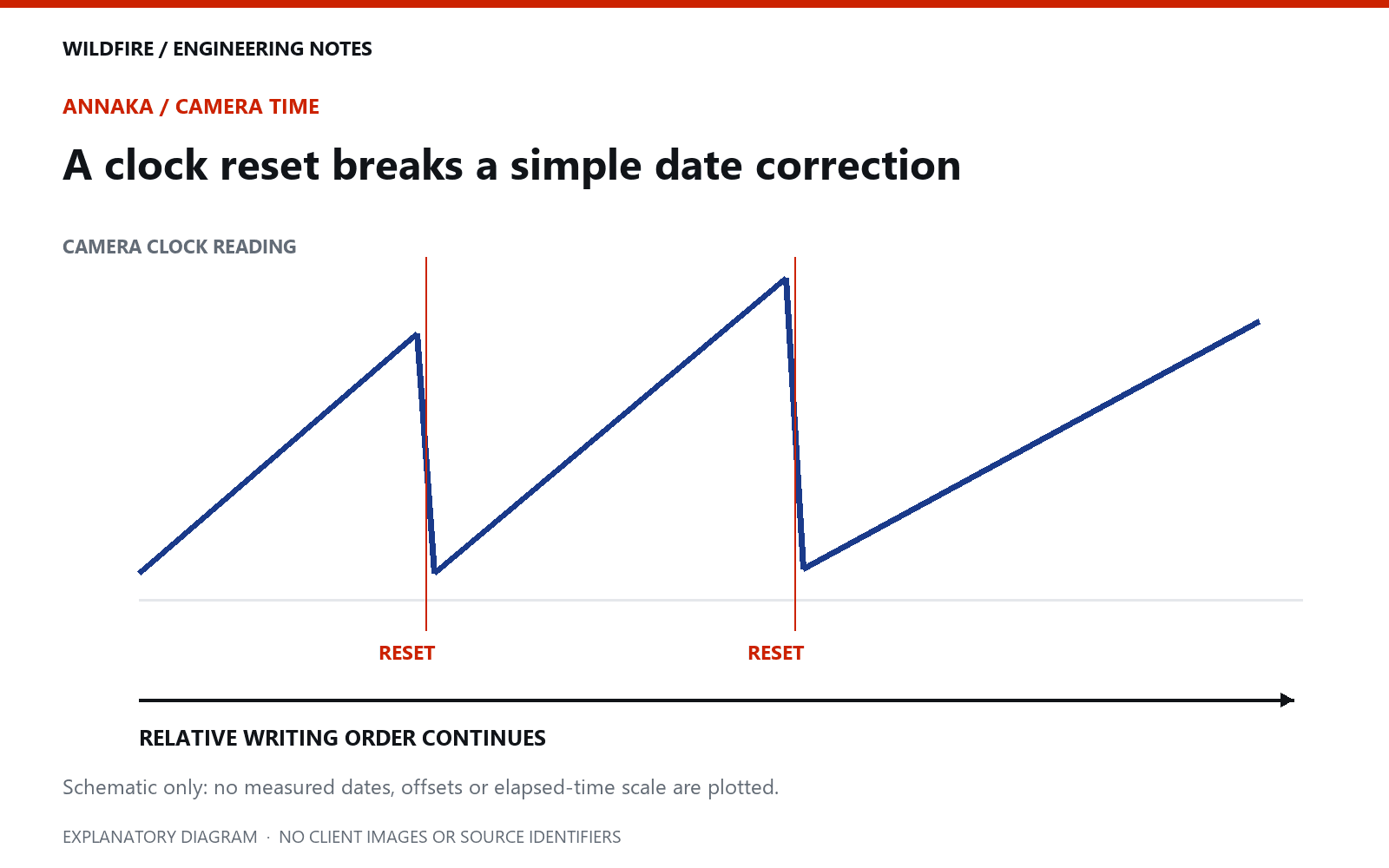
The recovery findings showed a pattern consistent with camera-clock resets. A timestamp written by a camera records what its clock believed at the time. A date drawn onto the picture can come from that same clock, so an on-screen date and a metadata date are not necessarily two independent confirmations.

We therefore did not reject a recording simply because it said 2019. Equally, we did not change every 2019 date into a 2026 date. Multiple apparent resets meant that one fixed correction could not establish a reliable calendar timeline for the whole card.
The useful evidence came from several places together: the relative writing sequence, the format boundary, the surviving recording structures and recognition of the recovered content. Metadata helped organise the investigation; client review was still needed to connect the recovered session to the remembered day.
Why a single date correction would be unsafe
If a camera clock were wrong by a constant amount throughout a collection, an independently established offset could be useful. Apparent resets break that assumption: two recordings with similar clock readings may come from different periods, and a later real-world recording can carry an earlier clock value.
Here, the safe working record keeps separate fields for the camera timestamp, relative writing sequence, session interpretation and any client-confirmed calendar date. A timestamp burned into the picture remains visible content from the camera; it is not treated as an external time source.
Engineering notes / 05
The latest session contained 27 recordings
WDR’s documented reconstruction result identified 27 recordings in the latest session. All 27 were reported complete, with their samples verified against the camera’s surviving tables and their reconstructed video files decoding without errors. The same area also yielded 28 photos that decoded.
Each recording had both a full-resolution 4K file and an LRV, or low-resolution preview. Those are two versions of one recording. Counting both as separate videos would inflate the apparent number of recordings without adding another moment of footage.
This distinction is easy to miss in a recovery folder containing many files. A useful delivery structure separates full-resolution videos, companion previews and still photos, then gives the client a recording-based inventory. The inventory answers “how many recordings?” rather than simply “how many files?”
The latest area also contained a small overwritten region, approximately 450 KB, suspected to have held the beginning of a photo. That loss remained qualified because its original content could not be established with certainty. Complete results for the 27 identified recordings did not mean every item ever stored in that area survived.
Engineering notes / 06
Why the newest 44 crossed into older footage
The requested collection was remembered as about 44 videos. On the card, the newest 27 formed the complete latest-session sequence. To reach 44 by the reconstructed write order, the next 17 had to come from before a format boundary.
That was a material difference, not an administrative detail. A folder containing 44 recovered recordings could satisfy a numerical target while mixing sessions the client did not intend to request. We needed to explain the boundary rather than allow the folder count to imply a single complete shoot.
The data could not establish why the remembered count differed. Possibilities included companion previews, still photos or recordings from an earlier session, but none was proven. Annaka’s review of the files and contact sheet was the appropriate next check. We did not label the difference a client mistake.
Making the count explicit in the delivery inventory
A recording inventory needs a stable recording identifier and separate fields for the full-resolution file, preview, session and quality status. That stops the same recording being counted twice and makes the older-session boundary visible in the delivery.
latest_recordings = 27
latest_preview_files = 27   # companions, not new recording events
latest_photos = 28          # separate media category
older_recordings_selected = 17

selected_recordings = latest_recordings + older_recordings_selected
assert selected_recordings == 44
assert latest_preview_files == latest_recordings
# This arithmetic does not establish the real recording date.
# It does not explain why the client remembered about 44 videos.
The arithmetic is deliberately simple; the recovery work that justifies the inputs is not. These lines are an explanatory reconciliation of reported counts, not the original Annaka reconstruction code. The essential output is a collection whose labels allow the client to distinguish full-resolution videos, preview companions, photos and older recordings.
Engineering notes / 07
Older material needed separate quality labels
The earlier-session remnants contained 89 identified recordings. Before a later re-run, 76 were reported clean, 12 had glitches affecting a few frames and one was partial because its beginning had been overwritten. Additional older photos were identified, but their validation status was not established in the case update.
Later acquisition work filled 80 of 127 previously problematic sectors, while 47 remained unreadable across three images. Improvement to some older clips was expected, but an expectation is not a verified result. The final quality of the selected older 17 therefore remained open at the documented stage.
For delivery, the latest complete session and the older material needed separate labels. A clean result from one area should not conceal defects in another, and a partially recovered older clip should not reduce the clarity of the successful latest-session result.
Why filling a sector is not the same as repairing a frame
The re-run findings described two different populations: 127 previously problematic sectors and 12 older recordings with short glitches. There is no one-to-one conversion between those counts. A missing sector can affect compressed picture data, an index, audio or an unused area, depending on where it falls. A damaged compressed sample may also affect later pictures that depend on it.
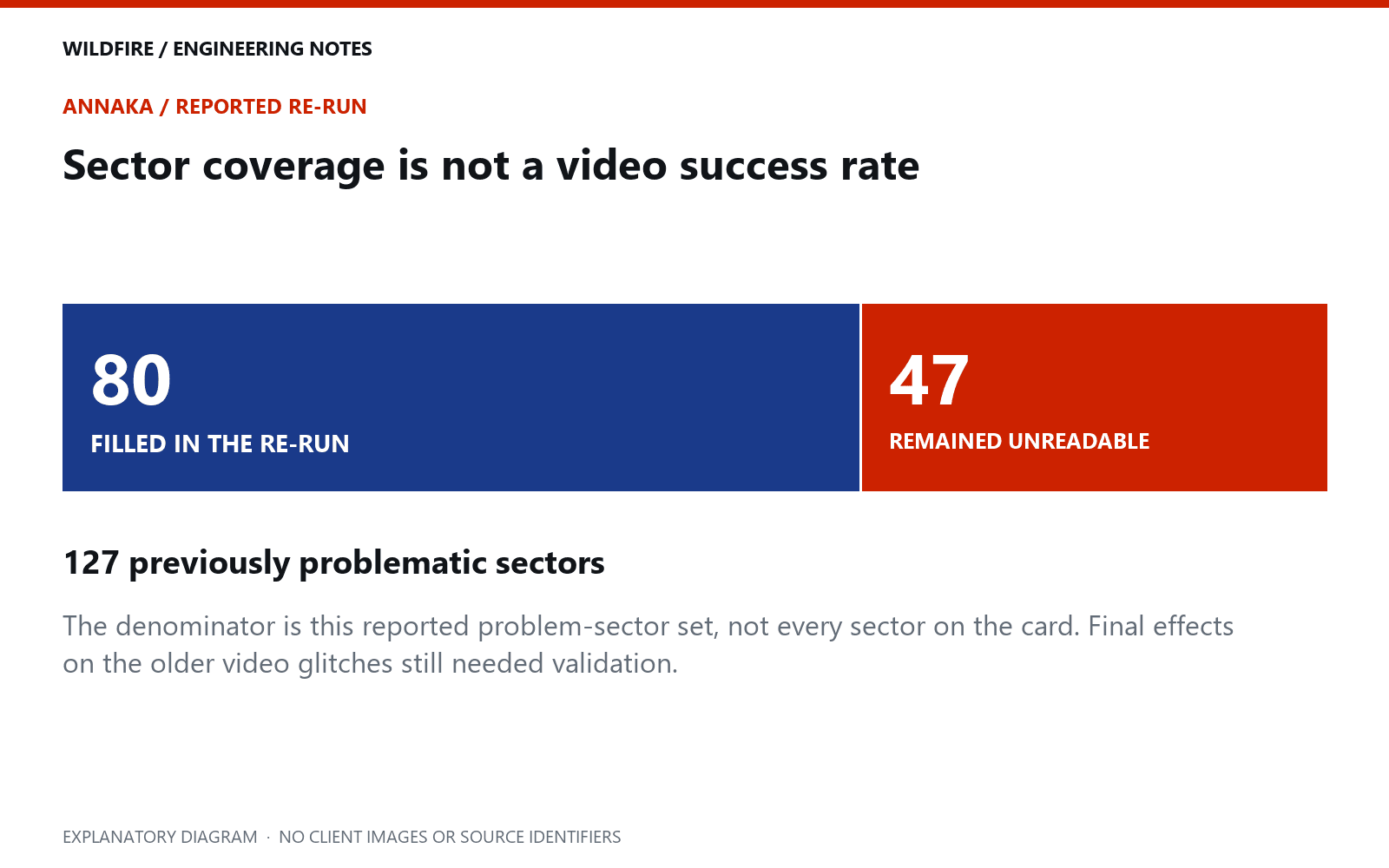
We therefore kept the pre-re-run quality categories—76 clean, 12 with short glitches and one partial—separate from the later acquisition progress. The final older-recording status requires a new full decode and visual review of the affected areas. It cannot be calculated simply by dividing 80 by 127.
Overwrite is a different limit again. For the older partial clip, the start was reported to have been replaced by newer data. Rebuilding a container header cannot bring back original image bytes that are no longer present. A deliverable should retain the partial label rather than hide the missing beginning behind a new timestamp or a shorter duration.
Engineering notes / 08
What this case teaches about SD-card recovery
An empty DCIM folder is a symptom, not a complete inventory of what remains. A date can help sort a collection without proving when it was filmed. A file count can include previews, photos and recordings from different sessions. Each of those shortcuts would have given an incomplete answer in this case.
Successful SD-card data recovery needs a clear brief as well as technical reconstruction. The client’s target session, the surviving material and the validation status should be explained together. Here, that meant reporting 27 complete latest-session recordings while keeping the 44-count question and older-file quality visible.
If your camera suddenly shows an empty folder, stop using the card for further recordings. Preserve the card and describe the sequence of events, including any format or recovery attempts. Save any recovery output to a different device. The sooner the actual history is understood, the sooner an assessment can focus on the data that matters.
Questions & answers
Questions this case helps answer
Does an empty DCIM folder mean the videos are gone?
Not necessarily. The directory view can fail even when some underlying recording data survives. Annaka’s latest session was reconstructed despite the earlier empty-folder view.
Can footage with the wrong date be the footage I need?
Yes. Camera clocks can be wrong, and the visible date may use the same clock as the metadata. Dates should be considered alongside recording order, content and client confirmation.
Are LRV files extra recordings?
In this case, each LRV was a preview companion to a full-resolution recording. The 27 full-resolution videos and their 27 previews represented 27 recordings.
Why were there 27 recent videos when about 44 were expected?
The latest identified session held 27 recordings. A selection of 44 included 17 older recordings across a format boundary. The reason for the difference from the remembered count was not established.
Does reconstructing a video restore overwritten footage?
No. Reconstruction can assemble surviving media and structures. It does not recreate original bytes that have been overwritten; gaps and partial results must be disclosed.
Missing camera footage needs a careful assessment
Tell WDR which session matters, what the camera displays and whether the card has been formatted or scanned. We will explain the findings and the limits of what has survived.
Request a recovery assessment Read about logical data recovery
Shared with permission using Annaka’s first name only. The headers and editorial artwork are AI-generated conceptual illustrations; technical diagrams are labelled separately. No client footage, faces or identifying locations are shown. Results describe this individual case at the documented stage and do not guarantee another recovery.